


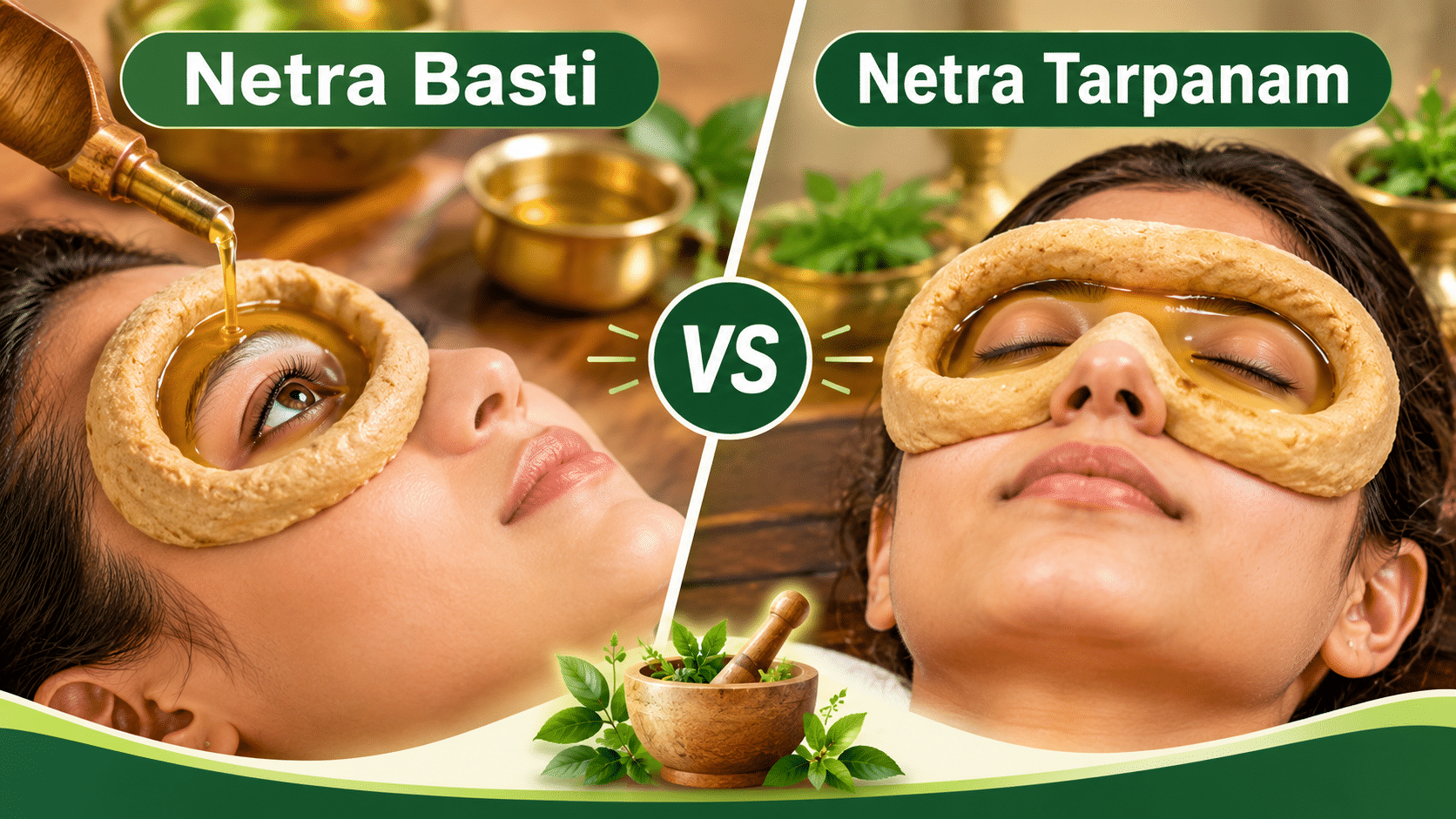
Among Ayurvedic eye therapies, Netra Tarpanam gets the most attention, but Netra Basti is another closely related treatment that often causes confusion. Both involve medicated ghee and a boundary around the eyes, so what’s actually different, and how do you know which one you need?
What Is Netra Basti?
Netra Basti is a classical Ayurvedic eye therapy where a taller boundary or “dam,” typically made from black gram (masha) flour dough, is built around the eyes, and warm medicated ghee is poured in and retained for a longer duration compared to Netra Tarpanam. The taller boundary allows for a greater quantity of ghee and a deeper, more prolonged saturation of the eye tissues.
What Is Netra Tarpanam?
Netra Tarpanam follows a similar principle, medicated ghee held over the eyes within a dough boundary, but typically uses a shorter boundary, a smaller quantity of ghee, and a shorter retention time. It’s generally considered a gentler, more routine therapy for nourishment and mild to moderate conditions.
Key Differences Between Netra Basti and Netra Tarpanam
1. Height of the Boundary and Ghee Quantity
Netra Basti uses a taller dam, allowing significantly more ghee to be held over the eyes compared to Netra Tarpanam’s shorter, more contained boundary.
2. Duration of Retention
Netra Basti sessions typically involve longer retention times, sometimes double that of a standard Tarpanam session, allowing for deeper tissue saturation.
3. Intensity and Purpose
Netra Basti is generally considered a more intensive therapy, often recommended for more chronic, stubborn, or advanced conditions where deeper nourishment is needed. Netra Tarpanam, while still effective, is more commonly used for general eye health maintenance, mild dryness, and computer vision syndrome.
4. Conditions Typically Treated
Netra Tarpanam is commonly recommended for:
- Mild to moderate dry eyes
- Computer vision syndrome and general eye strain
- Routine eye nourishment and maintenance
- Early-stage eye fatigue
Netra Basti is often recommended for:
- Chronic or severe dry eye syndrome unresponsive to Tarpanam alone
- Certain degenerative eye conditions as supportive care
- More advanced cases requiring deeper, more intensive nourishment
- Post-surgical supportive care in specific situations, under proper guidance
Which One Do You Need?
This decision should genuinely be made by a qualified Shalakya Tantra specialist based on:
- The severity and chronicity of your condition
- Your individual dosha constitution and current imbalance
- How you’ve responded to previous treatment, if any
- Any other underlying eye conditions that need to be factored in
Self-diagnosing which therapy you need isn’t advisable, since the wrong choice for your specific condition may not deliver optimal results, or in some cases, may not be appropriate at all.
What to Expect During Netra Basti
The procedure follows a similar overall process to Netra Tarpanam, but with some key differences in experience:
- A taller dough boundary is carefully constructed around the eyes to prevent leakage
- Warm medicated ghee is poured in until the eyes are fully submerged, up to the higher boundary
- Due to the greater ghee volume and boundary height, the session typically lasts longer than a standard Tarpanam
- The patient is asked to gently blink periodically throughout
- After the session, the ghee is carefully removed, and the eyes are gently cleaned
Because of its more intensive nature, Netra Basti sessions require careful supervision and are generally performed by experienced practitioners in a clinical Ayurvedic setting.
Are There More Precautions with Netra Basti?
Given its more intensive nature, Netra Basti typically requires a more thorough pre-assessment to confirm suitability, and practitioners may recommend a preparatory course of Netra Tarpanam first in certain cases before progressing to Basti, depending on the condition and the patient’s response.
Frequently Asked Questions
Q: Is Netra Basti more effective than Netra Tarpanam?
A: Not necessarily “more effective” in general, it’s more intensive and suited to different situations. For mild to moderate concerns, Netra Tarpanam is often sufficient and preferred; Netra Basti is reserved for more chronic or advanced cases.
Q: Does Netra Basti take longer to show results?
A: Given it’s typically used for more chronic conditions, the overall treatment course may be longer, but many patients report noticeable comfort even after their first session, similar to Netra Tarpanam.
Q: Can I request Netra Basti directly instead of starting with Netra Tarpanam?
A: It’s best to let your Shalakya Tantra specialist assess your condition first. They may start with Tarpanam and escalate to Basti if needed, rather than jumping directly to the more intensive therapy without assessment.
Final Thoughts
Netra Basti and Netra Tarpanam share the same foundational principle, nourishing the eyes with medicated ghee, but differ in intensity, duration, and the conditions they’re best suited for. Netra Tarpanam works well for general maintenance and mild concerns, while Netra Basti is reserved for more chronic or advanced conditions requiring deeper therapeutic intervention.
The right choice depends entirely on your specific condition, which is why consulting a qualified Ayurvedic eye specialist for proper assessment matters more than choosing based on general information alone.