

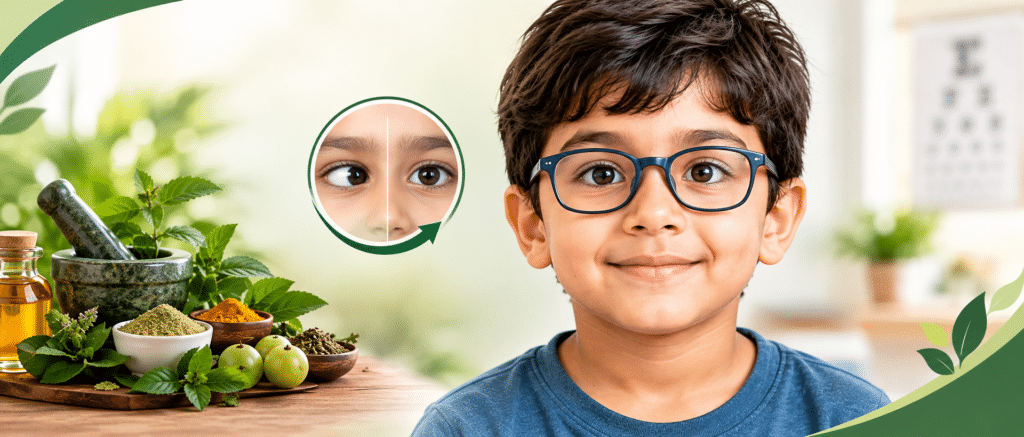
Lazy eye, medically called amblyopia, is a condition where one eye does not develop normal vision, even with glasses. It usually starts in childhood, and the earlier it is addressed, the better the outcome.
At Om Ayurveda Eye Care Centre, we offer supportive Ayurvedic care for lazy eye. We are also clear about one thing from the start: lazy eye needs proper vision correction and monitoring, and Ayurvedic therapy works best alongside that, not instead of it.
What Is Lazy Eye (Amblyopia)?
This page is your treatment guide. For the condition overview, see our Amblyopia page. Related conditions: squint and diplopia.
In lazy eye, the brain starts to favour one eye and ignores signals from the weaker one. The eye itself may look normal, but vision stays poor because the pathway between the eye and the brain did not develop fully. It is not simply a “weak eye muscle”, and it is not caused by laziness.
Types and Causes of Lazy Eye
Type | What happens |
Refractive amblyopia | A big difference in glasses power between the two eyes, so one eye sends a blurred picture |
Strabismic amblyopia | Squint (eyes not aligned), so the brain ignores the deviated eye to avoid double vision |
Deprivation amblyopia | Something blocks vision in one eye, such as a childhood cataract or a drooping eyelid |
Bilateral amblyopia | Both eyes have very high uncorrected power |
Why the Early Years Matter
The visual system develops fastest in early childhood. During this window, the brain is flexible and responds well to treatment. After the teen years, results are usually more limited. This is why a child’s eye check should not wait for complaints, because a child with lazy eye often does not know that anything is wrong.
Signs to Watch For in Children
- One eye drifting inward or outward
- Squinting or closing one eye
- Tilting the head to see
- Poor depth perception, bumping into things, missing when catching a ball
- Complaining that one eye cannot see well
- Rubbing one eye often
- Poor performance in class despite being bright
- Sitting very close to the TV or holding books close
Read our guide on protecting children’s eyes from screen exposure.
Signs by Age
- Infants: eyes that do not follow objects or look misaligned after the first few months
- Toddlers: head tilting, covering one eye, clumsiness
- School-age children: headaches, trouble copying from the board, avoiding reading
Standard Lazy Eye Treatment (What Your Eye Doctor May Advise)
Understanding the standard treatments helps you see where Ayurvedic care fits.
- Glasses: correcting the power often improves vision on its own
- Patching: covering the stronger eye for some hours a day so the weaker eye must work
- Atropine drops: blurring the stronger eye temporarily to push the weaker one to work
- Vision therapy and exercises: to improve coordination and focusing
- Treating the cause: such as surgery for a cataract, droopy lid or squint when needed
These are the foundation of lazy eye care. Do not skip or delay them.
How Ayurveda Supports Lazy Eye Treatment
Ayurveda cannot replace glasses, patching or other standard treatment that your eye doctor advises. What it can offer is supportive care that nourishes the eyes, reduces strain and supports overall eye and nervous system health during treatment.
Netra Tarpanam (Supportive Nourishment)
A gentle ghee-based therapy used to nourish the eyes and ease strain. Suitability for children is decided case by case. Read Netra Tarpanam explained and see the therapy page for Netra Tarpanam.
Eye Exercises and Focus Practices
Simple exercises, adapted to age, help with focus and coordination. See eye yoga exercises.
Internal Medicines and Nervous System Support
Gentle herbal medicines and calming therapies can support overall nourishment and sleep. See Ayurvedic herbs for eye health.
Diet and Lifestyle Guidance
Nutrition for growing eyes, healthy sleep and sensible screen limits support the treatment your child is already receiving. See foods for eye health.
Coordination With Your Eye Doctor
We encourage you to continue glasses, patching or any plan from your ophthalmologist. Our role is to support, and to be honest about what Ayurveda can and cannot do. Learn more in can Ayurveda improve eyesight without glasses.
Lazy Eye Treatment for Children
For children, we keep the approach gentle and practical:
- A friendly consultation with parents involved
- A clear explanation of what to expect
- Short, child-appropriate sessions where therapy is suitable
- A home routine parents can actually follow
- Regular review of progress
A Home Routine for Parents
- Keep to the glasses and patching plan, even when your child resists
- Make patching time fun with drawing, puzzles, beads or reading, which also exercise the weaker eye
- Set a daily outdoor play time
- Limit recreational screens and keep them at a good distance
- Offer eye-friendly foods such as carrots, leafy greens, almonds, fruit and water
- Keep a regular sleep time
- Praise effort and never tease about the patch or glasses
- Keep review dates
School and Screen Guidance
- Seat the child where they can see the board clearly and tell the teacher about the problem
- Keep reading material at a comfortable distance in good light
- Use the 20-20-20 habit in a child-friendly way: look far away every 20 minutes
- Take regular breaks from tablets and phones
Lazy Eye in Adults
Adults with lazy eye can still benefit from supportive care that reduces strain and improves comfort, although large improvement in vision is less likely than in childhood. Some adults do show gains with proper correction and therapy. Honest expectations matter, and we will explain yours after assessment. If you have double vision or a drooping lid, read about diplopia.
Myths and Facts
Myth: Lazy eye will fix itself as the child grows.
Fact: Without treatment it usually persists, and the window to improve it closes.
Myth: If the eye looks normal, vision is normal.
Fact: Lazy eye often looks completely normal from outside.
Myth: Patching is cruel and does not work.
Fact: Patching is one of the most proven treatments when used correctly.
Myth: Lazy eye is treated only with exercises.
Fact: Correction, patching and treating the cause come first.
Myth: Adults cannot be treated.
Fact: Improvement is more limited, but supportive care and correction can help.
Lazy Eye Treatment Cost
The cost depends on your age, the type of therapy advised, the number of sessions and the length of follow-up. We do not push fixed packages. [ADD: consultation fee or “Please call us for current charges”]. After your consultation, you will be told the recommended plan and its cost clearly, so you can decide with full information.
Lazy Eye Specialist Near Me: Why Om Ayurveda Eye Care
- Specialised Ayurvedic eye care (Shalakya Tantra). See what is Shalakya Tantra
- Honest, realistic guidance, with no false promises of a “cure”
- Willingness to work with your ophthalmologist
- Based in Gurugram, accessible from across Delhi NCR
Wondering how to pick the right clinic? Read how to choose an Ayurvedic eye clinic.
Frequently Asked Questions
Ayurveda may offer supportive care for general eye comfort, but there is no strong scientific evidence that Ayurvedic therapies cure lazy eye (amblyopia). Standard treatment, such as prescribed glasses, patching, or other treatments recommended by an eye specialist, remains essential.
Early childhood is generally the most effective time to treat lazy eye because the visual system is still developing. Early diagnosis and appropriate treatment can improve the chances of better vision.
Yes. Adults can seek assessment and treatment for lazy eye. Improvement may be more limited than in children, but some adults may benefit from appropriate treatment depending on their condition. An eye specialist can explain the likely outcomes.
Netra Tarpanam should only be considered for children after an appropriate professional assessment. It is not an established treatment for lazy eye and should never replace prescribed glasses, patching, or other recommended care. Do not attempt eye therapies at home.
Lazy eye treatment often takes several months and requires consistency. The duration depends on the child’s age, severity of amblyopia, and response to treatment. Regular follow-up appointments help monitor progress.
The cost depends on the eye examination, prescribed treatment plan, and follow-up requirements. Contact OM Ayurveda Eye Care Centre for information about consultation fees and available services.
OM Ayurveda Eye Care Centre in Sector 40, Gurugram, offers eye consultations and guidance for lazy eye. Visit the Eye OPD page to learn more about booking a consultation.
Lazy eye, medically known as amblyopia, develops when the brain and one eye do not work together normally during childhood. Common causes include squint, a significant difference in refractive power between the eyes, or an obstruction such as a cataract that interferes with vision development.
No. Lazy eye (amblyopia) refers to reduced vision in one or sometimes both eyes due to abnormal visual development. Squint (strabismus) occurs when the eyes are misaligned. A squint can cause lazy eye, but the two conditions are different. Learn more about squint treatment.
In some children, correctly prescribed glasses can significantly improve vision. Others may also need patching, atropine drops, or additional treatment recommended by an eye specialist.
Screen time is not a direct established cause of lazy eye. However, excessive screen use can contribute to eye strain and may reduce time spent outdoors. Children should have regular vision checks and balanced screen habits.
Yes. Vision improvement can regress in some children after treatment is reduced or stopped, particularly if treatment ends too early. Follow your eye specialist’s instructions and attend recommended follow-up appointments.
Treatment is generally most effective when started early in childhood. However, improvement may still be possible in older children and some adults. The potential benefit depends on individual circumstances, so an eye examination is important at any age.
Some children with lazy eye show no obvious symptoms. Squinting, closing one eye, difficulty judging distances, or problems with visual tasks may be warning signs. A comprehensive eye examination is the reliable way to diagnose the condition. Book an Eye OPD consultation.
A balanced diet supports normal eye health and visual development, but diet alone cannot treat lazy eye. Children with amblyopia need appropriate eye examinations and treatment based on the underlying cause.
OM Ayurveda Eye Care Centre provides inpatient services through its Eye IPD. Contact the centre to confirm whether admission is appropriate for your child’s needs and which services are available.