


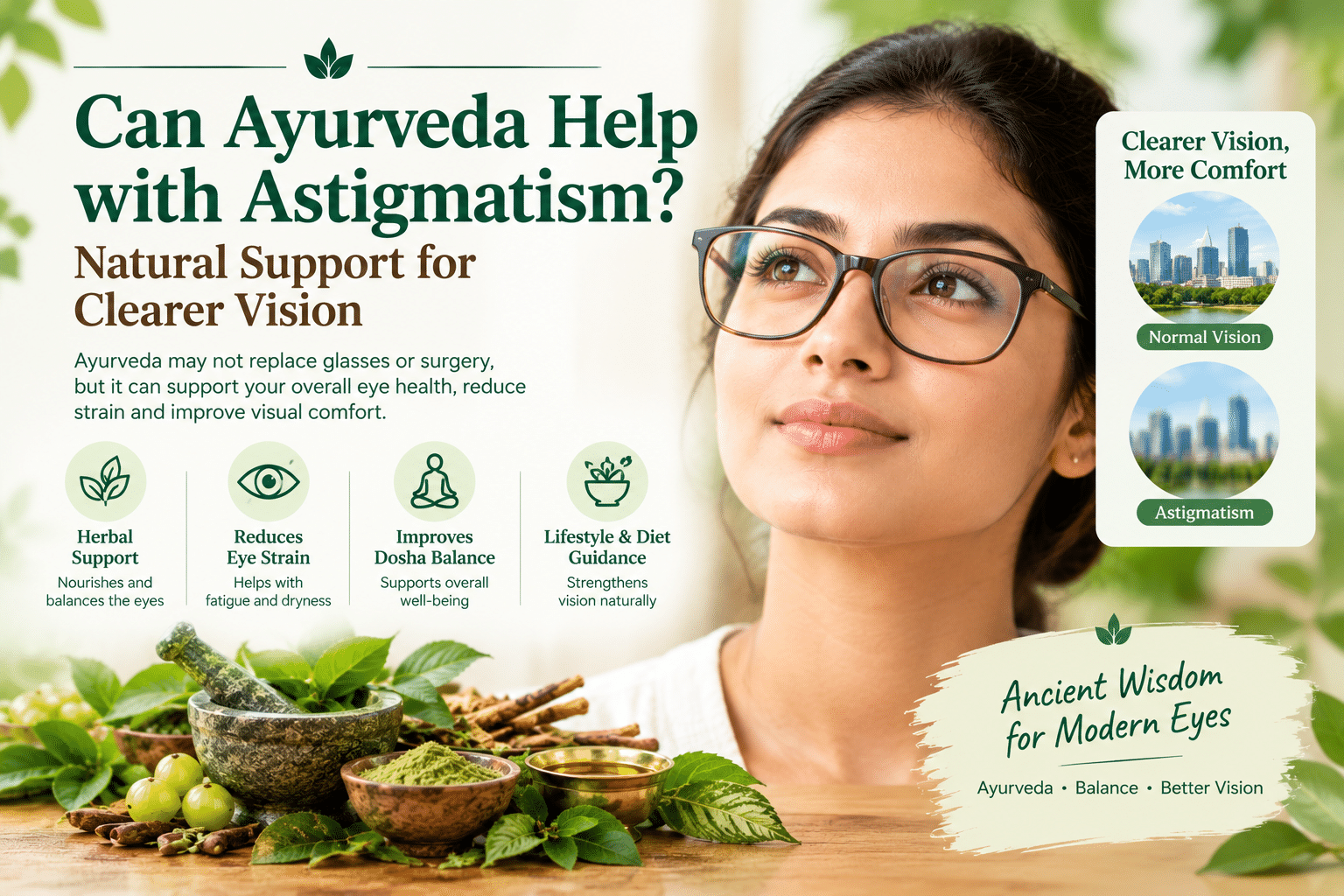
Astigmatism is one of the most common refractive errors, yet it’s often misunderstood compared to more widely discussed conditions like myopia or hyperopia. If you’ve recently been diagnosed and are wondering whether Ayurveda offers a natural way to correct it, here’s a clear, realistic answer.
What Is Astigmatism?
Astigmatism occurs when the cornea (or sometimes the lens) has an irregular curvature, more football-shaped than perfectly round, causing light to focus at multiple points instead of one single point on the retina. This results in blurred or distorted vision at all distances, unlike myopia or hyperopia, which typically affect only near or far vision specifically.
Common Symptoms of Astigmatism
- Blurred or distorted vision at any distance
- Eye strain and fatigue, especially with prolonged reading or screen use
- Headaches, particularly after visual tasks
- Difficulty with night vision
- Squinting to try to see more clearly
Can Ayurveda Correct Astigmatism?
Here’s the honest, direct answer: astigmatism is a structural, anatomical condition involving the physical curvature of the cornea or lens, and this shape cannot be changed through Ayurvedic herbs, eye washes, or dietary changes. Any claim promising to “cure” or fully correct astigmatism through natural remedies alone is not medically accurate.
Correction of astigmatism typically requires glasses, contact lenses (specifically toric lenses designed for astigmatism), or refractive surgery in eligible candidates, these remain the only ways to actually correct the optical distortion caused by the irregular curvature.
What Ayurveda Can Genuinely Offer
While Ayurveda cannot reshape the cornea, it can offer meaningful supportive benefits for people living with astigmatism:
1. Reducing Associated Eye Strain
People with uncorrected or even corrected astigmatism often experience more eye fatigue than those with normal vision, since the visual system works harder to compensate. Ayurvedic practices like palming, Netra Tarpanam, and conscious blinking can help reduce this associated strain.
2. Supporting Overall Eye Comfort
Therapies like Netra Tarpanam can help nourish and lubricate the eyes, which is particularly helpful since astigmatism-related strain often overlaps with dry eye symptoms from compensatory squinting and increased focusing effort.
3. Managing Screen-Related Fatigue
Since screen use tends to be more tiring for people with astigmatism, Ayurvedic guidance on screen breaks, lighting, and ergonomic setup can meaningfully improve day-to-day comfort.
4. Dietary Support for General Eye Health
While diet won’t change corneal shape, a nutrient-rich, Pitta-balancing diet supports overall eye tissue health and may help reduce the compounding effects of strain and dryness that often accompany astigmatism.
5. Reducing Headaches Linked to Visual Strain
Ayurvedic approaches to reducing Vata and Pitta aggravation, including proper sleep, stress management, and regular Abhyanga (oil massage), can help reduce the frequency of strain-related headaches common in uncorrected astigmatism.
What You Should Never Do
- Never delay getting a proper glasses or contact lens prescription for confirmed astigmatism in favor of trying to “fix” it naturally first, uncorrected astigmatism, especially in children, can affect visual development
- Never rely on unverified products claiming to reverse astigmatism without any lens correction
- Never skip regular eye exams, since astigmatism can change over time and needs periodic reassessment
A Sensible, Integrated Approach
If you have astigmatism and want to explore Ayurvedic support:
- Get properly corrected with the right glasses or contact lens prescription from your ophthalmologist or optometrist
- Use Ayurvedic practices specifically to manage the eye strain and fatigue that often accompanies astigmatism
- Maintain regular eye exams to monitor any changes in your prescription over time
- Consider therapies like Netra Tarpanam as supportive, comfort-focused care, not as a replacement for corrective lenses
Frequently Asked Questions
Q: Can eye exercises fix astigmatism?
A: No, eye exercises can improve focusing ability and reduce strain, but they cannot reshape the cornea, which is what would be needed to actually correct astigmatism.
Q: Does astigmatism get worse over time?
A: It can change gradually, especially during childhood and adolescence, or after certain eye conditions or injuries. Regular eye exams help track and adjust your correction as needed.
Q: Is surgery the only permanent solution for astigmatism?
A: Refractive surgery (like LASIK) can correct astigmatism permanently for eligible candidates, but glasses and contact lenses remain effective, non-surgical options for most people.
Final Thoughts
Astigmatism is a structural condition that Ayurveda cannot reshape or cure, and it’s important to be clear about this rather than delaying proper correction. However, Ayurvedic care can genuinely help manage the associated eye strain, fatigue, and dryness that often come with living with astigmatism, making it a valuable complement to, not a replacement for, proper vision correction.
If you’re managing astigmatism and experiencing ongoing eye strain, an Ayurvedic eye specialist can offer supportive care alongside your regular corrective lenses.