

If you’ve been searching for a natural approach to dry eyes, eye fatigue, or computer-related eye strain, you may have come across the term Netra Tarpanam.
This traditional Ayurvedic eye therapy has been used as part of Ayurvedic ophthalmic care and is often discussed in the context of eye nourishment and comfort.
But what exactly is Netra Tarpanam? How is it performed, what are its potential benefits, and who should avoid it?
Here’s a practical guide to understanding this classical Ayurvedic therapy.
What Is Netra Tarpanam?
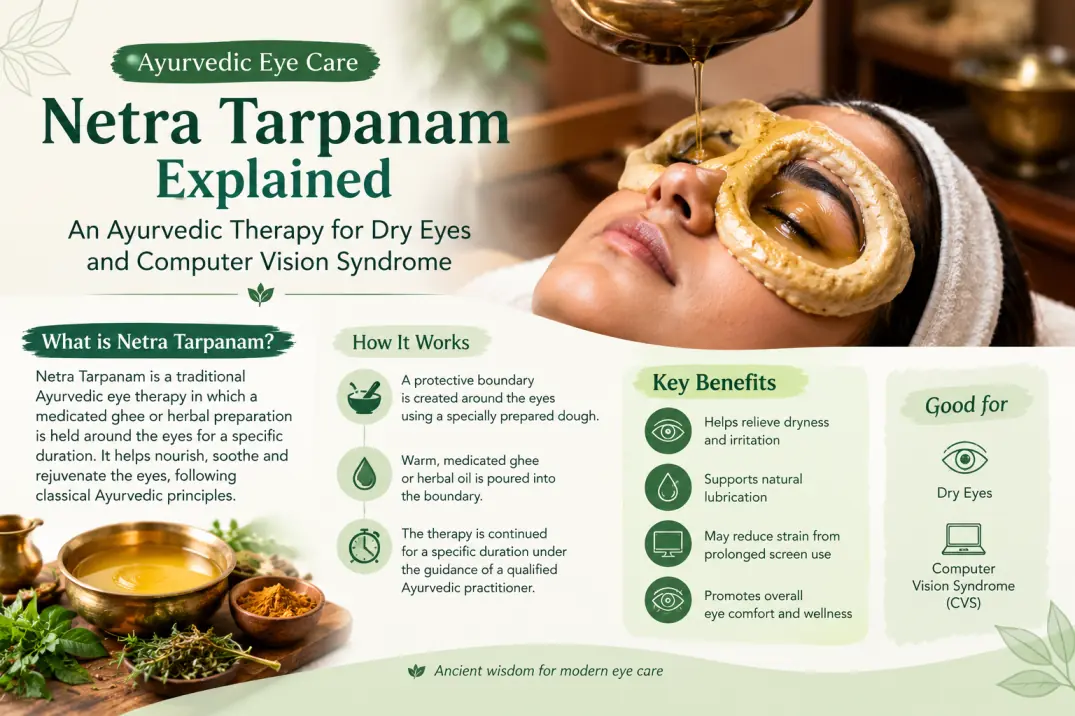
Netra Tarpanam is a traditional Ayurvedic ocular procedure that falls under Kriyakalpa, a group of classical Ayurvedic procedures used for eye care.
The word “Tarpana” broadly refers to nourishing or satiating. In Ayurvedic practice, Netra Tarpanam involves retaining a suitably prepared medicated ghee preparation around the eyes for a prescribed period.
The therapy is traditionally intended to support eye comfort, nourishment, and relaxation and is selected according to the individual’s condition and Ayurvedic assessment.
How Is Netra Tarpanam Performed?
A typical Netra Tarpanam procedure may involve the following steps:
1. Preparing the Eye Area
The patient is positioned comfortably, and a circular boundary or “dam” is carefully created around the eyes using an appropriate dough preparation.
2. Adding Medicated Ghee
A suitably prepared and appropriately warmed medicated ghee formulation is placed inside the enclosure around the eye area.
The specific formulation may vary depending on the Ayurvedic assessment and treatment objective.
3. Eye Exposure to the Preparation
Once the ghee is placed, the eyes may be gently opened and closed as instructed by the practitioner.
This allows the eyes to remain in contact with the preparation for the prescribed duration.
4. Retention Period
The preparation is retained for a duration determined by the practitioner based on the individual’s condition and treatment protocol.
The exact duration should not be assumed to be the same for every patient.
5. Cleaning and Post-Treatment Care
After the procedure, the preparation is carefully removed and the eye area is cleaned.
Patients may be advised to temporarily avoid bright light, dust, smoke, and prolonged screen exposure following the session.
What Conditions Is Netra Tarpanam Used For?
Netra Tarpanam may be considered as part of an Ayurvedic eye-care plan for certain symptoms and conditions, particularly where eye comfort and dryness are concerns.
It may be used in relation to:
Dryness and Eye Discomfort
The therapy is traditionally used to provide a nourishing and soothing experience for dry or uncomfortable eyes.
Computer-Related Eye Strain
People who spend long hours working on computers or mobile devices may experience tiredness, burning, temporary blurred vision, and discomfort.
Netra Tarpanam may be incorporated into an Ayurvedic approach for managing these symptoms.
Eye Fatigue and Strain
Students, professionals, and frequent screen users may experience eye fatigue due to prolonged near-work and insufficient breaks.
Ayurvedic eye-care practices may be used as part of a broader approach to improving eye comfort.
Supportive Eye Care
Depending on the individual’s condition, an Ayurvedic practitioner may recommend Netra Tarpanam alongside other therapies or lifestyle modifications.
However, it should not be considered a replacement for conventional diagnosis or treatment of conditions such as cataracts, glaucoma, retinal disorders, severe dry eye disease, or other serious eye conditions.
Potential Benefits of Netra Tarpanam
Traditional Ayurvedic practice associates Netra Tarpanam with several potential benefits, including:
- Supporting eye lubrication and comfort
- Helping reduce feelings of eye fatigue
- Providing a soothing experience for tired eyes
- Supporting relaxation around the eye area
- Helping manage discomfort associated with prolonged screen use
- Supporting an overall Ayurvedic eye-care routine
The response to treatment can vary significantly between individuals.
It is therefore better to view Netra Tarpanam as a supportive therapy rather than a guaranteed treatment for a specific eye condition.
Who Should Avoid Netra Tarpanam?
Netra Tarpanam may not be appropriate during certain acute eye conditions.
It should generally be avoided or postponed when there is:
- An active eye infection
- Significant eye inflammation
- Active conjunctivitis with discharge
- A recent eye injury or surgery
- A foreign body in the eye
- Significant unexplained eye pain or sudden vision changes
People with existing eye conditions should first undergo an appropriate evaluation before receiving the procedure.
This is why Netra Tarpanam should be performed by a qualified Ayurvedic practitioner trained in Shalakya Tantra, rather than being treated as a generic spa or wellness procedure.
How Many Sessions Are Needed?
There is no universal number of Netra Tarpanam sessions that applies to everyone.
The treatment schedule depends on factors such as:
- The individual’s symptoms
- Underlying condition
- Overall eye health
- Ayurvedic assessment
- Response to treatment
- Treatment protocol recommended by the practitioner
Some practitioners may recommend a short course of sessions for eye strain or dryness, followed by reassessment.
For chronic concerns, the practitioner may recommend additional sessions depending on the individual’s response.
What to Expect After Netra Tarpanam
Many people find the procedure relaxing and may experience a temporary feeling of comfort or reduced eye fatigue after a session.
However, individual responses vary.
If symptoms such as persistent dryness, blurred vision, pain, redness, flashes, floaters, or sudden changes in vision continue or worsen, an ophthalmic evaluation is important.
Netra Tarpanam should complement appropriate eye care rather than delay necessary medical treatment.
Frequently Asked Questions
Is Netra Tarpanam painful?
Netra Tarpanam is generally performed as a gentle, non-invasive Ayurvedic procedure. Many people find the experience relaxing.
However, if you experience pain, significant irritation, or discomfort during the procedure, inform the practitioner immediately.
How long do the effects of Netra Tarpanam last?
The duration of perceived benefits can vary depending on the individual’s symptoms, eye health, lifestyle, screen exposure, and other factors.
There is no fixed duration that can be guaranteed for everyone.
Can Netra Tarpanam be done at home?
It is not recommended to perform Netra Tarpanam at home without professional guidance.
The preparation, hygiene, temperature, duration, and suitability of the therapy should be assessed by a qualified practitioner.
Avoid putting unverified oils, ghee, or herbal preparations directly into the eyes.
Is Netra Tarpanam suitable for people who wear contact lenses?
Contact lenses should be removed before any procedure involving the eye area.
People who wear contact lenses should discuss when it is appropriate to resume wearing them with their eye-care professional or Ayurvedic practitioner.
Can Netra Tarpanam cure cataracts?
Netra Tarpanam should not be promoted as a cure for cataracts.
Cataracts involve changes in the eye’s natural lens and require proper ophthalmic assessment. When cataracts significantly affect vision, an ophthalmologist can advise on appropriate treatment options.
Can Netra Tarpanam improve eyesight?
Netra Tarpanam is traditionally used to support eye nourishment and comfort. It should not be presented as a guaranteed method for correcting refractive errors such as myopia, hyperopia, or astigmatism.
If your vision has become blurry or your glasses prescription has changed, get a professional eye examination.
Netra Tarpanam vs. Regular Eye Drops
Netra Tarpanam and conventional eye drops serve different purposes.
Artificial tears are commonly used to lubricate the ocular surface and manage symptoms of dry eye.
Netra Tarpanam is a traditional Ayurvedic procedure involving the controlled application of a medicated preparation around and over the eyes.
Neither approach is automatically appropriate for every person. The right option depends on the underlying cause of your symptoms.
For persistent dry eye symptoms, a professional eye examination can help identify whether the problem is related to tear production, evaporation, eyelid function, medications, environmental factors, or another condition.
Final Thoughts
Netra Tarpanam is a classical Ayurvedic eye-care procedure traditionally associated with nourishment, relaxation, and eye comfort.
For people experiencing dryness, eye fatigue, or discomfort associated with prolonged screen use, it may be considered as part of an individualized Ayurvedic care plan.
However, it is important to maintain realistic expectations. Netra Tarpanam should not be presented as a guaranteed cure for refractive errors, cataracts, retinal conditions, or other serious eye diseases.
If you’re experiencing persistent dry, tired, or strained eyes, consult a qualified Ayurvedic eye-care specialist for an individual assessment and appropriate treatment plan.
At Om Ayurveda EyeCare Centre, we can assess your eye-care needs and recommend an Ayurvedic treatment approach suited to your individual condition.